THE EV LIE: Why High Gas Prices Are Not a Good Reason to Buy an Electric Car
THE QUESTION
“Is now a good time to buy an electric vehicle because gas prices are so high?”
Short answer: It depends. You need to do the math and be realistic about your situation.
THE CONTEXT
Gasoline in California is at $6.15 per gallon the highest in the country. But the reason is the conflict with Iran, refinery closures in the state, and the high transportation cost of crude oil and its derivatives. The United States exports oil it doesn’t lack it. This is a temporary crisis, not the new normal.

THE FIRST QUESTION YOU MUST ASK YOURSELF
Do you have the ideal profile?
- A Level 2 charger at home, located within 25 feet of where you park
- Electricity that costs less than $0.28/kWh
- A daily commute (to the same location) of no more than 40–50 miles in heavy city traffic
If you meet all three conditions, here’s what the math looks like:
- A gas car costs you approximately $296/month in fuel today
- An EV charged at home costs approximately $113/month
- You save approximately $2,200 per year in fuel alone
Sounds good. But the EV costs $8,000 to $10,000 more than an equivalent gas car — and the $7,500 federal tax credit no longer exists. State credits exist, but you must qualify by income, zip code, and vehicle model — and they’re not guaranteed.
Real EV break-even: 4 years — but only if you meet all three conditions.
Sponsored Articles




THE 3 CONDITIONS YOU CANNOT NEGOTIATE
Without these three, the EV does not make economic sense:
- Level 2 charger at home
Without it, you’re charging at public stations at $0.42/kWh, and your savings disappear entirely. I have personally paid more at Superchargers than I would have spent on gasoline for the same miles.
- Electricity below $0.28/kWh
Ideally, on a nighttime rate. Look closely at what you actually pay and factor in that electricity costs have been rising an average of 2–3% per year.
- Daily urban driving of 40–50 miles
To the same destination like a round-trip commute to work. Not a frequent traveler, not a highway driver. The EV was built for stop-and-go city traffic.

THE KEY ARGUMENT — PAY ATTENTION
If gasoline drops back to $3.50 — the historical U.S. average — the EV break-even stretches to 7 or 8 years. By then, the battery has degraded, the warranty has expired, and the technology has changed. And a used EV has poor resale value — nobody wants to tell you that replacement batteries can cost more than $4,000.
You are making a 7-year financial decision based on a 6-month crisis.
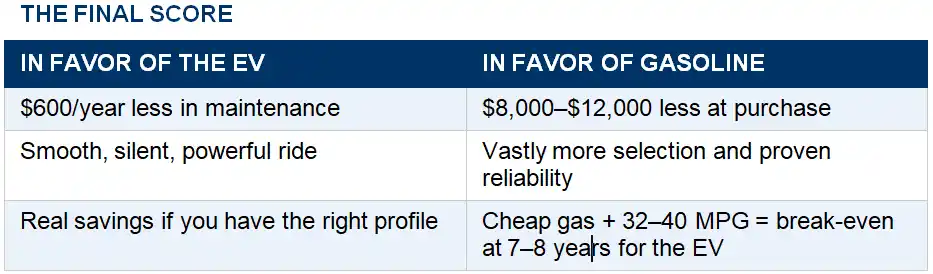
The electric car has a market but it’s for people who have a home charger, pay for cheap electricity, and drive in the city every day. Buying one now out of panic over gas prices is making a 7-year financial decision based on a 7-month crisis. Know yourself before you walk into a dealership. Don’t be swayed by ads showing low monthly payments on electric cars. Those are leases on models that aren’t selling.
And here’s the number that says it all: in the United States, with every incentive that existed, with all the advertising, with Elon Musk in the headlines every single day only 9 out of every 100 Americans chose an electric car. That tells you everything about where the market actually stands.
We also cannot compare ourselves to China. They produce electricity at the lowest cost in the world — and that is precisely why they have emphasized electric powertrains. That is not the reality in America.